Somatic Physics / Practice Plates
Elemental Vibration
A sequence of body experiments for reading threshold, resonance, damping, phase-lock, and drift through direct sensation.
Earth
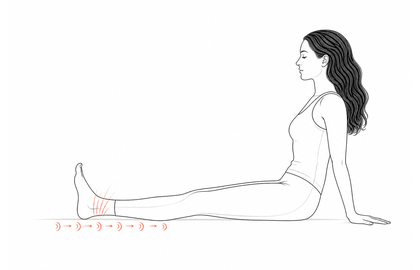 Heel Stick-Slip Recurrence
Sit on the floor with legs extended.
Heel Stick-Slip Recurrence
Sit on the floor with legs extended.
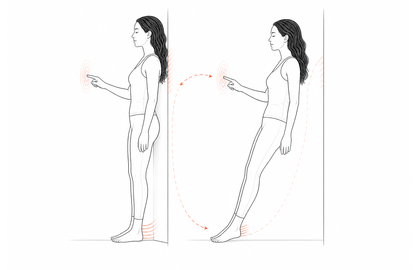 Wall-Contact Hysteresis Loop
Stand against a wall, heels and back lightly in contact. Map the width of that loop: how far past the contact point you must go to break contact, versus how far back you must come to remake it.
Wall-Contact Hysteresis Loop
Stand against a wall, heels and back lightly in contact. Map the width of that loop: how far past the contact point you must go to break contact, versus how far back you must come to remake it.
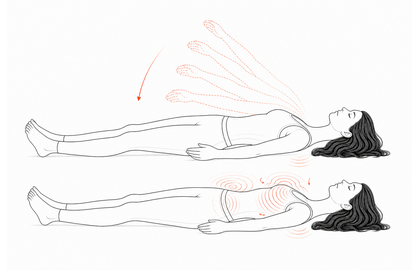 Arm-Drop Overshoot Settle
Lie supine with arms overhead. Map the direction of the overshoot at each segment.
Arm-Drop Overshoot Settle
Lie supine with arms overhead. Map the direction of the overshoot at each segment.
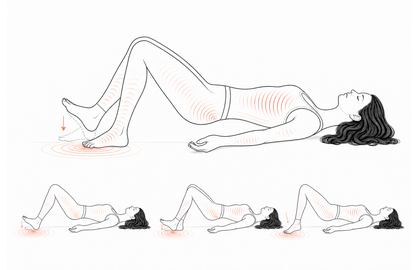 Random Heel-Drop Impulse Response
Lie supine, knees bent. Track the impulse response — how the abdomen, ribs, and left leg react to each drop — and ask whether responses are identical or whether the same impulse evokes different shapes depending on what the body was doing just before.
Random Heel-Drop Impulse Response
Lie supine, knees bent. Track the impulse response — how the abdomen, ribs, and left leg react to each drop — and ask whether responses are identical or whether the same impulse evokes different shapes depending on what the body was doing just before.
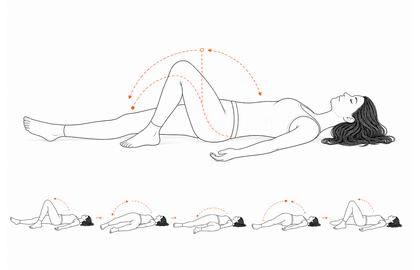 Knee-Fall Path Reversal
Lie supine. Repeat at a steady tempo.
Knee-Fall Path Reversal
Lie supine. Repeat at a steady tempo.
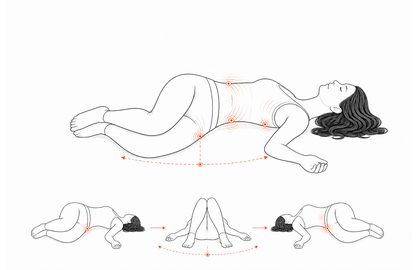 Pelvic-Drop Minimal Release
Lie supine, knees bent, and start a slow alternating drop of the knees side to side, period about three seconds, small range. Identify the precise muscle whose release initiates the drop — obliques, quadratus, glute medius — and find the smallest possible release that still...
Pelvic-Drop Minimal Release
Lie supine, knees bent, and start a slow alternating drop of the knees side to side, period about three seconds, small range. Identify the precise muscle whose release initiates the drop — obliques, quadratus, glute medius — and find the smallest possible release that still...
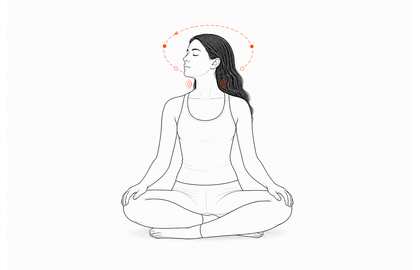 Head-Circle Apparent Wind
Sit cross-legged with the spine vertical and let the head start a slow circling motion, no larger than a coin's diameter, at the rate of one circle per two seconds. Identify the two points on the circle where the suboccipital effort drops nearly to zero and the two points...
Head-Circle Apparent Wind
Sit cross-legged with the spine vertical and let the head start a slow circling motion, no larger than a coin's diameter, at the rate of one circle per two seconds. Identify the two points on the circle where the suboccipital effort drops nearly to zero and the two points...
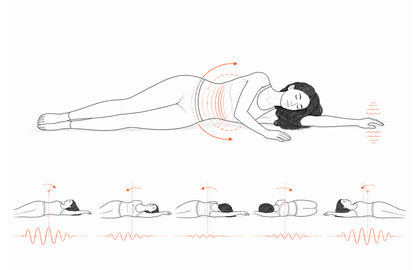 Tourbillon Torso-Yaw Tremor Map
Lie on your side with the lower arm extended above your head and the upper hip stacked, then introduce a slow yaw rotation of the entire torso around its long axis — once every ten seconds, ten degrees in each direction. Map which torso angle most distorts the hand's small...
Tourbillon Torso-Yaw Tremor Map
Lie on your side with the lower arm extended above your head and the upper hip stacked, then introduce a slow yaw rotation of the entire torso around its long axis — once every ten seconds, ten degrees in each direction. Map which torso angle most distorts the hand's small...
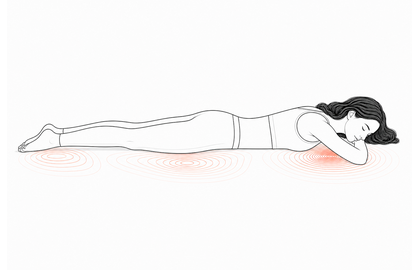 Prone Pressure-Contour Gradient
Lie prone and mentally draw level curves of pressure on the floor — isolines connecting points of equal contact force. Locate the steepest pressure gradient under your body and track how it migrates as you make minute postural changes.
Prone Pressure-Contour Gradient
Lie prone and mentally draw level curves of pressure on the floor — isolines connecting points of equal contact force. Locate the steepest pressure gradient under your body and track how it migrates as you make minute postural changes.
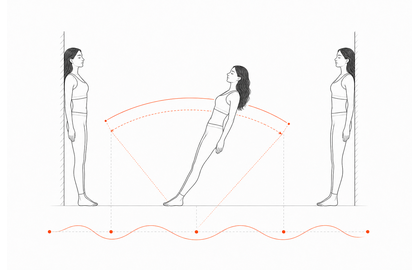 Wall Fall-and-Catch Hysteresis
Stand and lean very slightly against a wall with one shoulder, then push off into a slow, repeated falling-and-catching pattern away from the wall and back. Map the gap between those two angles.
Wall Fall-and-Catch Hysteresis
Stand and lean very slightly against a wall with one shoulder, then push off into a slow, repeated falling-and-catching pattern away from the wall and back. Map the gap between those two angles.
Water
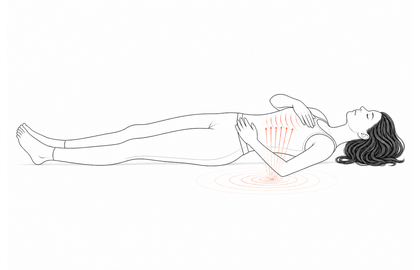 Diaphragm Containment Leak
Lie supine with the right palm on the lower abdomen and the left palm on the sternum.
Diaphragm Containment Leak
Lie supine with the right palm on the lower abdomen and the left palm on the sternum.
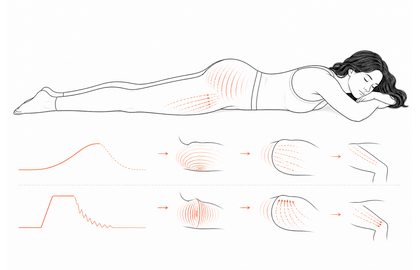 Gluteal Slow-vs-Fast Ramp Dispersion
Lie prone, forehead on stacked hands. Detect where the two responses differ — which fiber regions feel recruited in the fast version but not the slow, and where the slow version produces tension that the fast version skips over.
Gluteal Slow-vs-Fast Ramp Dispersion
Lie prone, forehead on stacked hands. Detect where the two responses differ — which fiber regions feel recruited in the fast version but not the slow, and where the slow version produces tension that the fast version skips over.
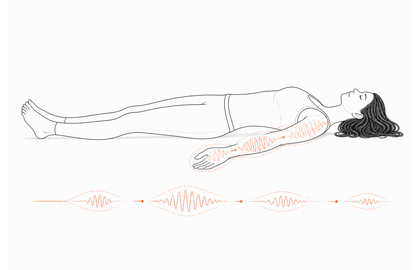 Arm Wave Group-vs-Phase Velocity
Lie supine, arms long beside you. Detect group velocity versus phase velocity: where in the arm does the envelope of the tremor travel slower than the individual oscillations within it?
Arm Wave Group-vs-Phase Velocity
Lie supine, arms long beside you. Detect group velocity versus phase velocity: where in the arm does the envelope of the tremor travel slower than the individual oscillations within it?
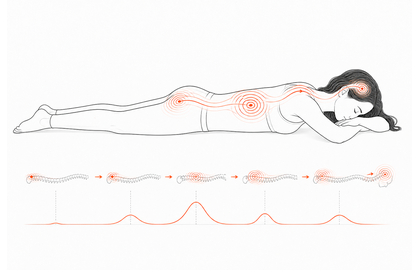 Spinal Wave Retention Times
Lie prone, forehead on stacked hands. Identify which spinal levels are "fast" (low retention) and which are "slow" — the slow ones are not stiff, they are highly absorbent.
Spinal Wave Retention Times
Lie prone, forehead on stacked hands. Identify which spinal levels are "fast" (low retention) and which are "slow" — the slow ones are not stiff, they are highly absorbent.
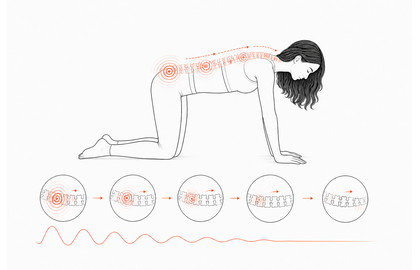 Fused-Plate Spinal Segments
Kneel on all fours. Detect which spinal segments refuse the gradient — segments that insist on moving at the same rate as their neighbors, behaving as a fused plate rather than a distinct stage.
Fused-Plate Spinal Segments
Kneel on all fours. Detect which spinal segments refuse the gradient — segments that insist on moving at the same rate as their neighbors, behaving as a fused plate rather than a distinct stage.
Air
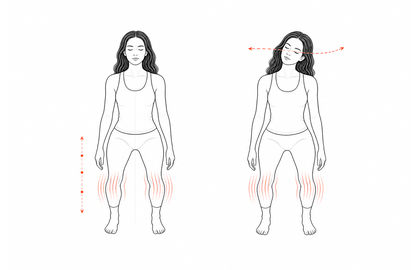 Knee-Bend Noise Floor
Stand and drop into a small, repeated knee bend — a vertical oscillation around mid-height, never going deep. Find that threshold by increasing head amplitude in small steps and noting the precise amplitude at which the knee count first slips.
Knee-Bend Noise Floor
Stand and drop into a small, repeated knee bend — a vertical oscillation around mid-height, never going deep. Find that threshold by increasing head amplitude in small steps and noting the precise amplitude at which the knee count first slips.
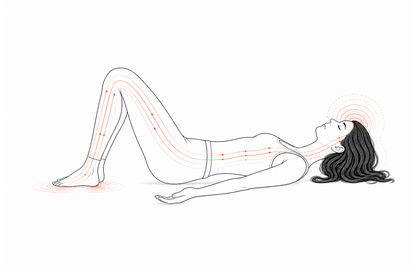 Foot-to-Skull Resonance Sweep
Lie supine, soles of feet on the floor, knees up. Find this resonance peak, name its frequency by counting, and then nudge slightly above and below to map how sharp the peak is — its Q.
Foot-to-Skull Resonance Sweep
Lie supine, soles of feet on the floor, knees up. Find this resonance peak, name its frequency by counting, and then nudge slightly above and below to map how sharp the peak is — its Q.
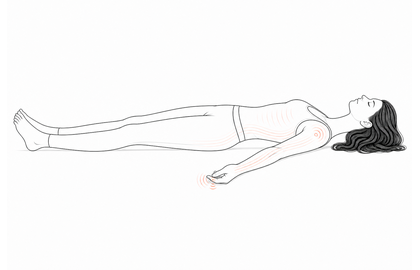 Sympathetic Joint Vibration
Supine, arms by the sides. Locate the second site in the body that begins to vibrate sympathetically without your asking it to — a quiver at the wrist, a flicker at the shoulder, a small motion at the jaw.
Sympathetic Joint Vibration
Supine, arms by the sides. Locate the second site in the body that begins to vibrate sympathetically without your asking it to — a quiver at the wrist, a flicker at the shoulder, a small motion at the jaw.
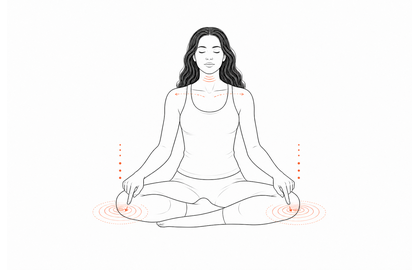 Bimanual Beat Secret Coupler
Sit cross-legged or on the floor with hands on the knees. Track the moment your shoulders, jaw, or breath try to phase-lock the two hands together against your intent.
Bimanual Beat Secret Coupler
Sit cross-legged or on the floor with hands on the knees. Track the moment your shoulders, jaw, or breath try to phase-lock the two hands together against your intent.
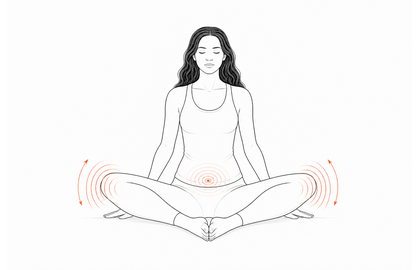 Leg-Loop Standing-Wave Node
Sit on the floor, knees bent, soles together (a comfortable distance from the perineum). Locate the node of this body-string: it is not the feet but somewhere in the lower abdomen or sacrum.
Leg-Loop Standing-Wave Node
Sit on the floor, knees bent, soles together (a comfortable distance from the perineum). Locate the node of this body-string: it is not the feet but somewhere in the lower abdomen or sacrum.
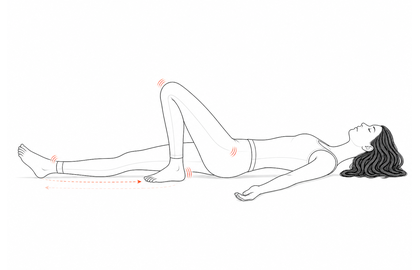 Slow-Heel-Drag Micro-Jitter Census
Lie supine and slowly drag one heel along the floor toward the buttock, then push it back out, repeating at a near-imperceptible speed. Count the joints producing detectable micro-jitter and rank them by amplitude.
Slow-Heel-Drag Micro-Jitter Census
Lie supine and slowly drag one heel along the floor toward the buttock, then push it back out, repeating at a near-imperceptible speed. Count the joints producing detectable micro-jitter and rank them by amplitude.
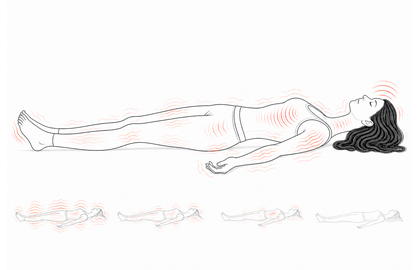 Voluntary-Shiver Damping Map
Lie supine, full body long. Repeat after a few minutes and check whether attention alone has moved any region from one column to the other.
Voluntary-Shiver Damping Map
Lie supine, full body long. Repeat after a few minutes and check whether attention alone has moved any region from one column to the other.
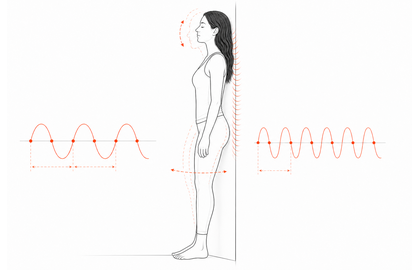 Wall-Pelvis Phase-Lock Ratios
Stand against a wall with the back lightly contacting it from sacrum to occiput, and produce small forward-back micro-shifts of the pelvis against the wall surface. Map the integer ratios at which lock occurs (1:1, 1:2, 2:3) and which one feels most thermodynamically stable,...
Wall-Pelvis Phase-Lock Ratios
Stand against a wall with the back lightly contacting it from sacrum to occiput, and produce small forward-back micro-shifts of the pelvis against the wall surface. Map the integer ratios at which lock occurs (1:1, 1:2, 2:3) and which one feels most thermodynamically stable,...
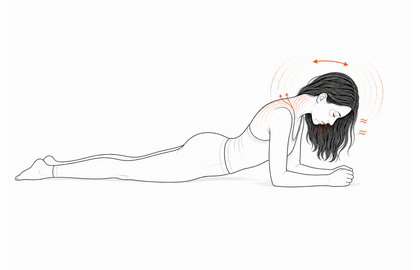 Neck Ring-Down: Jaw, Tongue, Eyes
Prone, propped on elbows. Count the half-cycles until the head settles.
Neck Ring-Down: Jaw, Tongue, Eyes
Prone, propped on elbows. Count the half-cycles until the head settles.
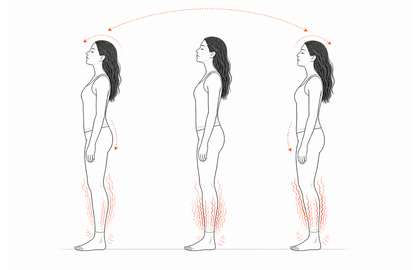 Calf-Tremor Postural Inversion
Stand with feet hip-width. Detect the postural moment of inversion — the instant when the short-range jitter starts dictating where the head goes — and identify what reorganizes itself one to two seconds after the inversion lands.
Calf-Tremor Postural Inversion
Stand with feet hip-width. Detect the postural moment of inversion — the instant when the short-range jitter starts dictating where the head goes — and identify what reorganizes itself one to two seconds after the inversion lands.
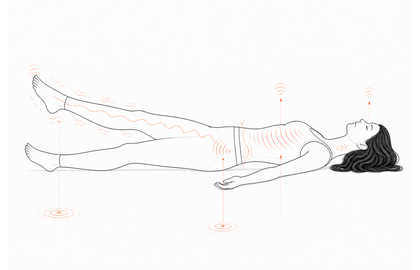 Stilled-Leg Tremor Spectrum
Lie supine.
Stilled-Leg Tremor Spectrum
Lie supine.
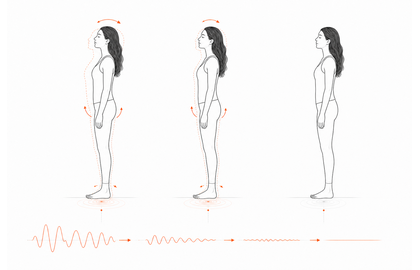 Postural Microseism Subtraction
Stand with feet hip-width, weight even. Find the amplitude at which the involuntary sway becomes louder than the voluntary one.
Postural Microseism Subtraction
Stand with feet hip-width, weight even. Find the amplitude at which the involuntary sway becomes louder than the voluntary one.
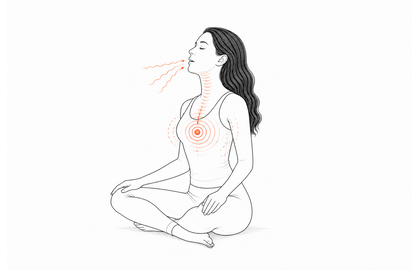 Hum-vs-Silent Sternum Resonance
Sit upright on the floor, spine free. Compare the two sensations and locating the difference: the silent attempt will likely miss the resonance because the cavity's eigenfrequency depends on tissue tone you cannot voluntarily set.
Hum-vs-Silent Sternum Resonance
Sit upright on the floor, spine free. Compare the two sensations and locating the difference: the silent attempt will likely miss the resonance because the cavity's eigenfrequency depends on tissue tone you cannot voluntarily set.
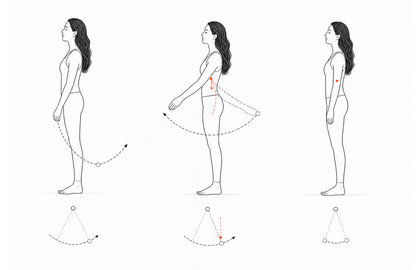 Arm Swing Negative Resonance
Stand and let your arms hang.
Arm Swing Negative Resonance
Stand and let your arms hang.
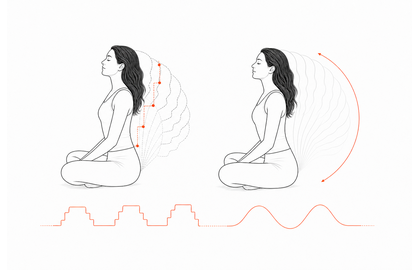 Stepped-Rock Sampling Limit
Sit cross-legged and rock the torso forward and back at roughly one Hz, but deliberately break the cycle into discrete steps — sample-and-hold rather than continuous sweep. Find the step rate at which the discretization becomes invisible to the body — where it phase-locks to...
Stepped-Rock Sampling Limit
Sit cross-legged and rock the torso forward and back at roughly one Hz, but deliberately break the cycle into discrete steps — sample-and-hold rather than continuous sweep. Find the step rate at which the discretization becomes invisible to the body — where it phase-locks to...
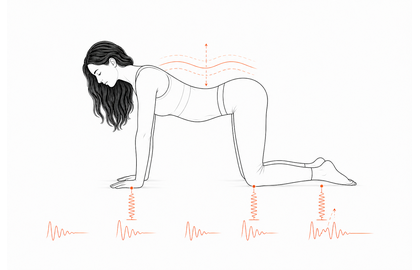 Quadruped Four-Spring Eigenmode
On hands and knees in a stable quadruped, sag the belly slightly and let the spine begin a slow vertical bobbing — not cat-cow shape change, but a quasi-rigid oscillation up and down.
Quadruped Four-Spring Eigenmode
On hands and knees in a stable quadruped, sag the belly slightly and let the spine begin a slow vertical bobbing — not cat-cow shape change, but a quasi-rigid oscillation up and down.
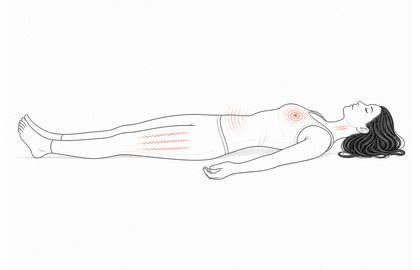 Passive Oscillation Inventory
Lie supine, completely passive, and inventory the involuntary oscillations you can detect: heartbeat in the chest, pulse in the carotid, a tremor in a relaxed quadriceps, the slow rise and fall of the abdomen. Identify the slowest involuntary oscillation, the fastest, and any...
Passive Oscillation Inventory
Lie supine, completely passive, and inventory the involuntary oscillations you can detect: heartbeat in the chest, pulse in the carotid, a tremor in a relaxed quadriceps, the slow rise and fall of the abdomen. Identify the slowest involuntary oscillation, the fastest, and any...
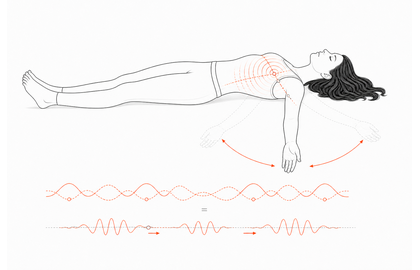 Quadrature-Arm Sternal Node Migration
Supine, arms at sides, set the right arm swinging at the shoulder in small arcs across the floor at a comfortable tempo, then start the left arm at the same tempo but deliberately a quarter-cycle out of phase. Locate the sternal site where the two arms' contributions cancel —...
Quadrature-Arm Sternal Node Migration
Supine, arms at sides, set the right arm swinging at the shoulder in small arcs across the floor at a comfortable tempo, then start the left arm at the same tempo but deliberately a quarter-cycle out of phase. Locate the sternal site where the two arms' contributions cancel —...
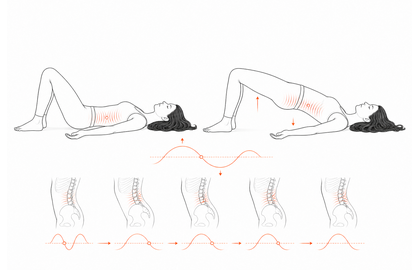 Bridge-Driven Lumbar Node Sweep
Lie supine and produce a slow, repeated bridge motion: lifting the pelvis a few centimeters and lowering it on a steady cycle. Determine whether the node — the vertebra that does not move — migrates along the spine with frequency, locks to a single anatomical landmark...
Bridge-Driven Lumbar Node Sweep
Lie supine and produce a slow, repeated bridge motion: lifting the pelvis a few centimeters and lowering it on a steady cycle. Determine whether the node — the vertebra that does not move — migrates along the spine with frequency, locks to a single anatomical landmark...
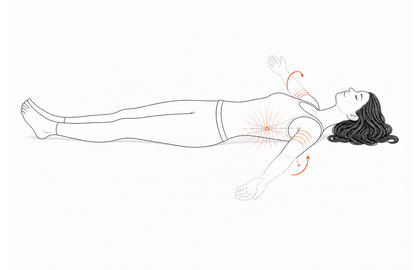 Symmetric Humeral Thoracic Node
Lie supine, arms abducted to roughly forty-five degrees, and oscillate both arms simultaneously in tiny internal-external rotations of the humerus at the same rate. Locate the node in the upper back: the vertebral level that stays motionless while everything above and below...
Symmetric Humeral Thoracic Node
Lie supine, arms abducted to roughly forty-five degrees, and oscillate both arms simultaneously in tiny internal-external rotations of the humerus at the same rate. Locate the node in the upper back: the vertebral level that stays motionless while everything above and below...
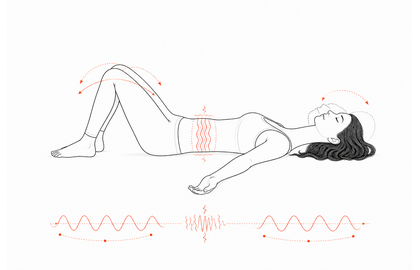 Lock-Boundary Arbitration Camp
Lie supine, knees bent, feet flat.
Lock-Boundary Arbitration Camp
Lie supine, knees bent, feet flat.
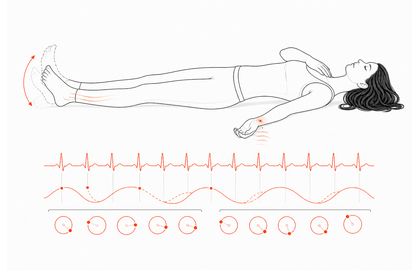 Foot-to-Pulse Subharmonic Lock
Lie supine and choose a phase-lock target: the heart rate at the wrist or carotid is a built-in clock.
Foot-to-Pulse Subharmonic Lock
Lie supine and choose a phase-lock target: the heart rate at the wrist or carotid is a built-in clock.
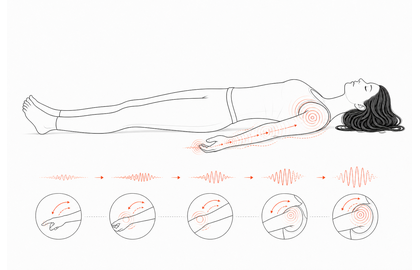 Finger-to-Shoulder Recruitment Hysteresis
On your back, arms by your sides, start the smallest possible oscillation in the right hand — a finger curl-uncurl at maybe two cycles per second. Locate the exact frequency at which each joint snaps into the wave, and notice whether you can drop back below that threshold...
Finger-to-Shoulder Recruitment Hysteresis
On your back, arms by your sides, start the smallest possible oscillation in the right hand — a finger curl-uncurl at maybe two cycles per second. Locate the exact frequency at which each joint snaps into the wave, and notice whether you can drop back below that threshold...
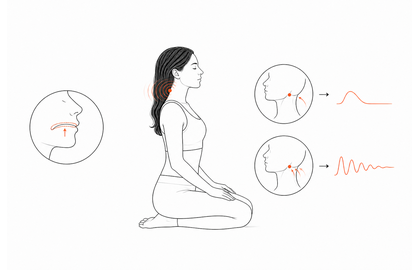 Tongue-Press Neck Damping Class
Sit upright. Observe what happens at the atlanto-occipital joint on release: a single settle, or multiple micro-rebounds.
Tongue-Press Neck Damping Class
Sit upright. Observe what happens at the atlanto-occipital joint on release: a single settle, or multiple micro-rebounds.
Fire
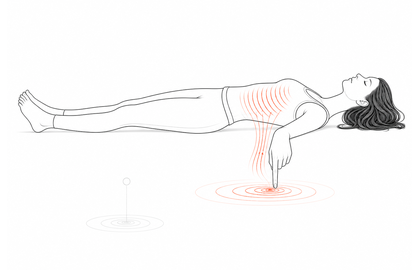 Rib Quorum Threshold
Lie supine. Locate the precise force at which the rib system flips from non-response to response, and whether that threshold drifts upward (sensitization) or downward (habituation) over a minute.
Rib Quorum Threshold
Lie supine. Locate the precise force at which the rib system flips from non-response to response, and whether that threshold drifts upward (sensitization) or downward (habituation) over a minute.
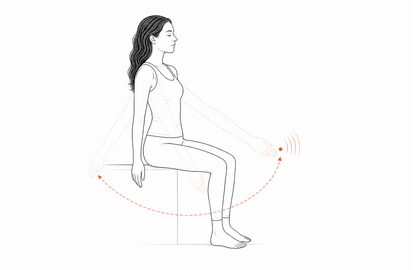 Arm Pendulum Parametric Drive
Stand or sit, and let one arm hang. Find the minimum push that maintains amplitude indefinitely, then find the push timing that requires the largest force to achieve the same amplitude.
Arm Pendulum Parametric Drive
Stand or sit, and let one arm hang. Find the minimum push that maintains amplitude indefinitely, then find the push timing that requires the largest force to achieve the same amplitude.
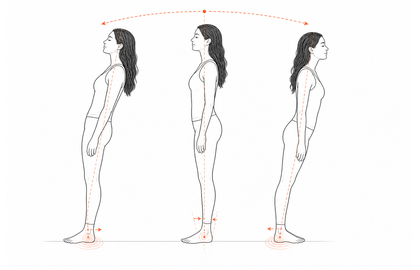 Ankle Escapement Phase Window
Stand with feet hip-width and let the body sway forward-back like an inverted pendulum hinged at the ankles, amplitude no greater than two centimeters at the crown.
Ankle Escapement Phase Window
Stand with feet hip-width and let the body sway forward-back like an inverted pendulum hinged at the ankles, amplitude no greater than two centimeters at the crown.
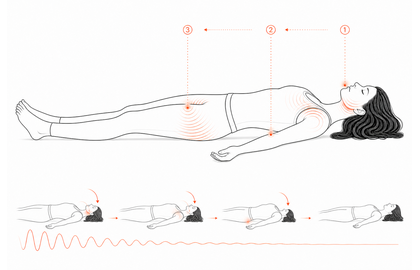 Tension-Release Sequence Test
Lie supine with held tension distributed across jaw, shoulders, and pelvis.
Tension-Release Sequence Test
Lie supine with held tension distributed across jaw, shoulders, and pelvis.
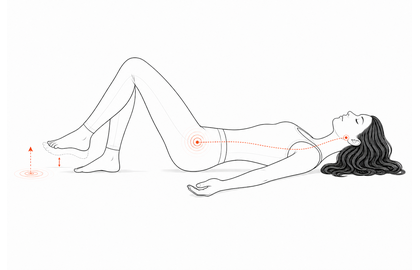 Jaw-as-Brake Foot Lift
Lie supine, knees bent. Identify the muscle that is contracted to keep it there.
Jaw-as-Brake Foot Lift
Lie supine, knees bent. Identify the muscle that is contracted to keep it there.
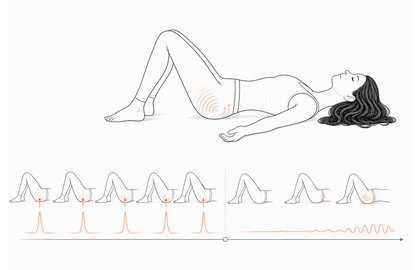 Gluteal-Pulse Annealing Schedule
Lie supine, knees bent, and rapidly contract and release the right gluteus several times — five short pulses.
Gluteal-Pulse Annealing Schedule
Lie supine, knees bent, and rapidly contract and release the right gluteus several times — five short pulses.
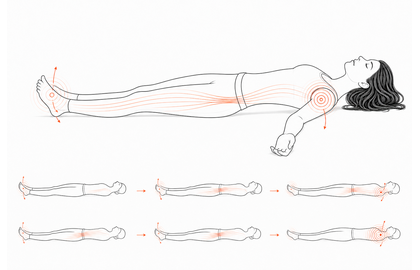 Ankle-Shoulder Energy Transfer
Lie on your back, legs long, arms long. Mark where in the torso the energy seems to cross.
Ankle-Shoulder Energy Transfer
Lie on your back, legs long, arms long. Mark where in the torso the energy seems to cross.
Space
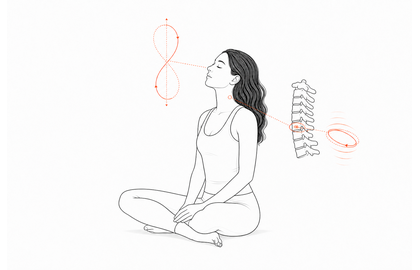 Nose Figure-Eight Lissajous Slip
Sit cross-legged and slowly draw a vertical figure-eight in the air with the nose, using neck and upper spine. Detect the instant the ratio slips: when the nose stops drawing a clean eight and begins drawing an oval, a tilted line, or a knotted loop.
Nose Figure-Eight Lissajous Slip
Sit cross-legged and slowly draw a vertical figure-eight in the air with the nose, using neck and upper spine. Detect the instant the ratio slips: when the nose stops drawing a clean eight and begins drawing an oval, a tilted line, or a knotted loop.
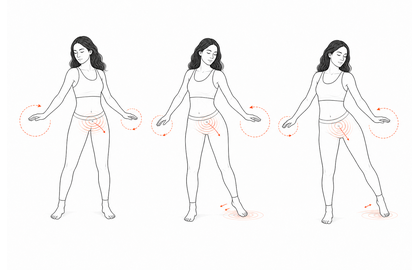 Counter-Rotating Hands Pelvis Collapse
Stand.
Counter-Rotating Hands Pelvis Collapse
Stand.
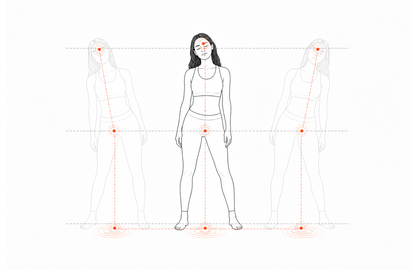 Three-Frame Center-of-Mass Datum
Stand and locate your center of mass, first taking the floor as the reference frame, then the pelvis, then the head. Identify which frame makes the smallest motion most legible, and which frame conceals it.
Three-Frame Center-of-Mass Datum
Stand and locate your center of mass, first taking the floor as the reference frame, then the pelvis, then the head. Identify which frame makes the smallest motion most legible, and which frame conceals it.
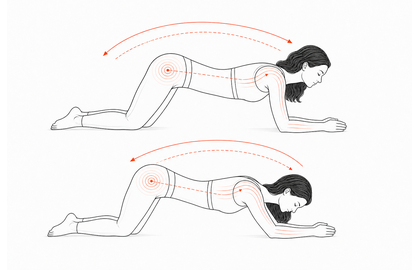 Hip-Locked Quadruped Reconstruction
Quadruped, then lower onto forearms.
Hip-Locked Quadruped Reconstruction
Quadruped, then lower onto forearms.