Air
Foot-to-Pulse Subharmonic Lock
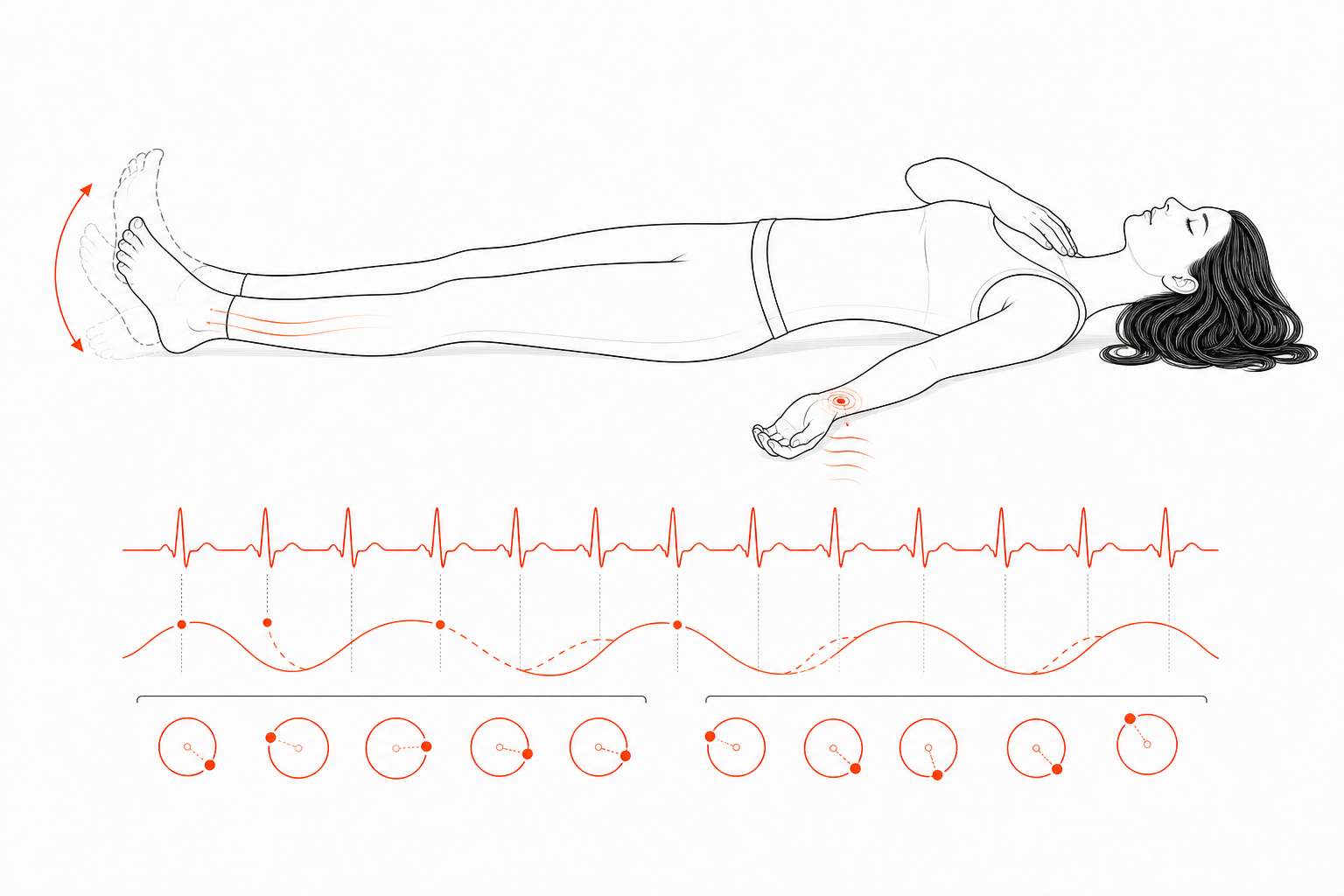
Lie supine and choose a phase-lock target: the heart rate at the wrist or carotid is a built-in clock.
Full Lesson Notes
Complete Practice
Lie supine and choose a phase-lock target: the heart rate at the wrist or carotid is a built-in clock. Begin a slow, small oscillation of one foot — flexion-extension at the ankle — and try to lock its frequency to a precise sub-harmonic of the pulse: one foot cycle per four heartbeats, say. Do not match breath, match pulse. Discover at what sub-harmonic ratio the lock is stable without drift, and at which ratios it slips. The slipping ratios are forbidden phase relations between your skeletal motion and your cardiovascular oscillator; the stable ones are the natural couplings. --- Challenge: Hearing one's own pulse precisely enough to lock a movement to one-third of it requires either stethoscope-grade interoception or a finger on the carotid, both borderline-equipment.